See below and attached, information about the upcoming “Raptors, Uplands & Peatlands” 2 day Conference being held in Sheffield in early September 2016 – see map for details.
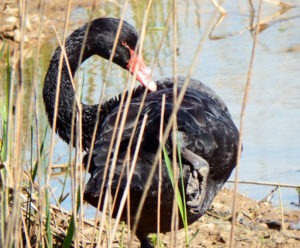
The seven club members who turned up for the visit to DWT Willington last weekend (15/6) could be excused for thinking they’d switched continents as a Black Swan swam serenely in front of the newly-constructed hide overlooking the reserve’s main pool.
Black Swan
Not counting this (probable) escapee, the group saw a collective total of around 45 species in the two and a half hours spent along the linear route that ends up at the hide.
Several warblers were heard if not always seen, including Cetti’s for which Willington is something of a stronghold.
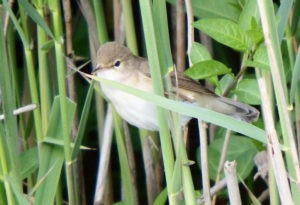
Reed and Sedge Warblers kept up a chattering among the reeds and low willows, while Chiffchaffs, Whitethroats and Garden and Willow Warblers periodically announced their presence.
Reed Warbler
Hunting above the reserve were Swallows and Martins, later joined by a sizeable contingent of Swifts.
A distant Cuckoo was heard twice, Buzzard and Kestrel were the only raptors seen, but it was the water loving species – waders, wildfowl, gulls and terns – that stole the show.
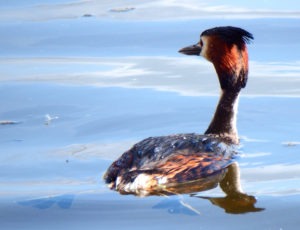
Great Crested Grebe
The full list of birds seen by one or more of the party were as follows:
Swallow, Sand Martin, House Martin, Blackbird, Wood Pigeon, Chiffchaff, Wren, Song Thrush, Great Tit, Garden Warbler, Cuckoo, Chaffinch, Cetti’s Warbler, Great Spotted Woodpecker, Bullfinch, Greenfinch, Sedge Warbler, Buzzard, Robin, Kestrel, Whitethroat, Canada Goose,
The club decided to go closer to home than usual when staging the latest members’ trip. Yet the Derbyshire Wildlife Trust’s Drakelow reserve – near Burton on Trent, and right on the border with Staffordshire – is still a fair journey for those among the nine-strong group who’d travelled the farthest, from Buxton and Chesterfield.
The reserve lies close to the River Trent and has a mix of habitats with some lakes and smaller lagoons, plenty of woodland cover and, being an old power station site, extensive flat open spaces.
We were met shortly after 9am by the reserve’s keen recorder Syd Garton, who took the time to explain the geography and what was around that day. The first bird I noted, while we were still in the small car park, was Common Tern, three of which were circling overhead before tracking down the Trent.
From one of the three hides, there were good views of an island hosting a huge colony of Cormorants, most of which were making plenty of noise in their nests dotted among the guano-spattered tree tops. We’d also been told about a quiet crossing point among reeds farther into the reserve, and viewable from another smaller hide, where we might see Water Rail. Well, we did! Or, at least, we caught a glimpse of a couple of the chicks, all black except for their light-coloured bills, as they sprinted across the clearing.
Walking around the woodlands areas, the usual springtime suspects rang out their familiar songs – Willow Warbler, Reed Warbler and the occasional Sedge, plus Chiffchaff, Blackcap and Whitethroat – joining the resident birds such as Reed Bunting, Wren, Blackbird, Song Thrush and Robin. A Cuckoo was heard and, by following its song, we got scopes trained on it as it settled down for some minutes in the top of a tree.
On leaving the reserve, via a half-mile access road, we stopped alongside open ground and heard Skylarks and, as though by way of a parting boost to our tally, a Red-legged Partridge and Lapwing showed themselves among the long grass, and a pair of Shelducks flew low overhead.
While each of us had just 40-odd species in our notebooks by the time we left the site, comparing notes afterwards it emerged that the group had collectively seen 50 species – quite a haul for a Sunday morning.
The full list is as follows: Common Tern, Magpie, Wood pigeon, Cormorant, Grey Heron, Tufted Duck, Wren, Chiffchaff, Black-headed Gull, Swift, Greylag Goose, Robin, Gt Crested Grebe, Coot, Green Woodpecker, Blackbird, Carrion Crow, Mallard, Reed Bunting, Pheasant, Reed Warbler, Water Rail, Long-tail’d Tit, Blackcap, Blue Tit, Mute Swan, Moorhen, Little Grebe, Buzzard, Willow Warbler, Cuckoo, Kestrel, Sedge Warbler, Lesser Black-back Gull, House Sparrow, Gt Spotted Woodpecker, Sand Martin, Dunnock, Song Thrush, Chaffinch, Swallow, Canada Goose, Oystercatcher, Sparrowhawk, Gadwall, Great Tit, Whitethroat, Red-legged Partridge, Lapwing, Skylark and Shelduck.