CHAIRMAN’S THOUGHTS
Before launching into my main topic for this issue, can I remind you it’s not too late to renew your membership for 2015: it’s £10 for a family and £7.50 for a single; if you want to rejoin please either e-mail me at the address listed at the end of the newsletter, or write a cheque and send it to me at 25 Church Street, Holloway DE4 5AY.
Last Friday morning at 05.30 I turned off the TV I’d been watching non-stop since 10pm the previous day. Like many people in our country I was perplexed, confused and amazed at the result, which I presume the bookies had not expected either. Well, at the same time the election polls closed that night so did another one – for Britain’s National Bird. This poll apparently attracted over 116,000 voters, though we won’t know the result of this until early June! David Lindo (aka the Urban Birder) felt that we should have a national bird and began a campaign to select one, which quickly gathered pace.
As long ago as June 20th 1782 the newly independent United States of America chose the Bald Eagle as its emblem. It was initially to be the Golden Eagle but it was rejected as not being wholly American (they weren’t to know at the time that their final choice was also found in other countries!). Some objected to its choice. No less a personality than Benjamin Franklin called it “… a bird of bad moral character, he does not get his living honestly… and besides, he is a rank coward“. Franklin preferred, ironically enough, the Turkey. There are many other examples of national birds as emblems all round the world, so David thought we deserved one, too.
Sixty birds were chosen originally and 70,000 voters helped him whittle it down to a final ten. Some that didn’t make it, like Swallows, were considered ‘non-doms’ as they only lived in the UK for part of the year. Another, the Rose-ringed Parakeet, was considered an illegal immigrant from foreign shores, so didn’t make the final either. Whether you voted or not, the final ten – listed below – were democratically elected by the public. Will the result be another shock?
National Bird – the candidates …
- Robin – the bookies’ favourite though recent comments have cast doubts because of its extreme pugnacity, as it is ruthlessly territorial. Besides that it has been pointed out that those in your winter garden could be from Poland or Germany as our regulars have skipped off to warmer places. It could also be said that it gets enough publicity at Christmas anyway when it’s a bit like the Beckhams of the Bird World!
- Hen Harrier – a seriously political nomination. This bird is persecuted by ‘the landed classes’ as was seen by a recent report of three males missing from the Bowland area. Chris Packham says your children and grandchildren will never see it at this rate and it’s the only candidate which could really gain from your votes and nomination.
- Red Kite – a proven survivor. One commentator says it’s ‘too recent’ a bird, but tell that to the people of Wales. It could well get the Plaid Cymru vote.
- Puffin – a strikingly beautiful bird, and a real poser. As it’s only with us ‘ashore’ during the breeding season and then only in certain, often remote places it has probably not been seen by many UK residents except on TV. The Daily Mail, which gave a ‘Britishness’ and ‘Looks’ score out of 10 for all candidates, marked the Puffin 5 and 9, respectively. And a Guardian writer claims it’s ‘too Icelandic’. Remember the Cod Wars?
- Kingfisher – arguably even better looking than the previous candidate. In fact, it gets a full ‘10’ for Looks with the DM. Again how many people in the UK have seen it and even the Guardian says it is ‘too rare’.
- Mute Swan – dismissed by the Guardian as ‘too regal’. As the British Monarch retains the right of ownership to all unmarked swans in open water then this is probably a fair comment. I imagine it won’t be getting the vote of Republicans in the UK. Besides, it is has been the national bird of Denmark since 1984. It does actually also claim benefits it is not entitled to claiming to be mute! Despite all this it was one of the favourites, especially after some ‘spider letters’ from you know who!
- Barn Owl – dismissed as ‘too quiet’ by a newspaper commentator, and it does have the handicap of not being seen by too many people. A successful breeding season last year may increase its numbers but it is still scarce – but beautiful, receiving an ‘8’ for Looks from the DM. It is also one of those few birds that can be found all over the world. Perhaps it will have the vote of that army of Harry Potter fans.
- Blackbird – running the Robin close. Many people’s favourite and probably the most recognisable and easily named by all, except perhaps the brown female. Its song is beautiful and its agent says ‘it brings joy to everyone’. It starts the Dawn Chorus off and is found many times in books, plays, poems and song, actually appearing at the end of a Beatles number! Fame indeed. Unfortunately it is Sweden’s national bird.
- Blue Tit – gets an 8 for Britishness and 8 for Looks by DM. A very high score and who has not had it in their Great British Garden Watch list. Common but a cute and dapper little bird that takes to bird boxes in our garden as readily as any bird. Clever enough to pass on knowledge about milk top tampering to the next generation. Whichever bird wins is going to be presented to the Government to create a law making it our national bird. I think it would appear to be biased to present to our new Conservative Government a bird with the word ‘BLUE’ at the beginning of its name.
- Wren – last but not least despite being the smallest of the candidates. Given only a ‘3’ for Looks by DM, but feisty and independent yet sociable (unlike the Robin) as dozens cram into a wintry hidey-hole to keep warm. The Wren’s lusty vocal performance, heard at any time of year and in any place, reflects its sheer joie de vivre. This tiny songster weighs just one-third of an ounce, but sings with 10 times the relative power of a crowing (French) cockerel. At a time when our nation needs more and more houses, this bird is an inspiration, building more than one nest to present a choice to a female, and its name is the same as our greatest architect. It is also truly a ‘nationwide’ bird being found at the most extreme parts of the country including St Kilda and the Shetlands. For those as old as me, you must remember the farthing coin with one of these birds on the back. So if it is too late to ‘vote for the small, the commonplace, the little guy with the big heart’ then it’s not too late to dig out those old coins and put two farthings each way on the Wren – and if it doesn’t win you are only losing a penny!
HELLO TO SUMMER VISITORS – ADIEU TO THE DIVER
An annual landmark came on 7 May, with the departure of our now familiar Great Northern Diver, and this followed several smaller milestones carefully logged each year with the arrival of our summer visitors.
First on the scene as usual was the Chiffchaff, first noted on 10 March though as many as 15 were seen by the end of the month. Sand Martin numbers grew quickly from the first sighting on 20 March, three days before two males on the dam wall represented the first Wheatears of 2015. After that, the arrivals checked in with increasing regularity during April – Swallow (3rd), Blackcap (8th) and Willow Warbler (9th) were joined later in the month by Redstart and Garden, Reed and Sedge Warblers.
A circular walk is a good way to gauge of the health of our warbler population and on 1 May more than 50 Blackcaps and Chiffchaffs were counted, along with 25 Willow Warblers and 14 Garden Warblers, 7 Whitethroats, 2 Lesser Whitethroats and single Sedge and Reed Warblers, though three of the latter species were heard singing in Hopton Reedbed on 10 May. Meanwhile, Rock Pipit was seen twice in late March and a site-scarce Tree Pipit was noted on 21 April.
On the water, among the more unusual sights were three Egyptian Geese on 22 March and a week later a Black-necked Grebe – not the first of the past winter – while 144 Whooper Swans flew through on 13-14 March. Little Egrets continued their excellent attendance record with four sightings during March and April, and two Avocets on 14 March were the first at Carsington since 2009 and only the fifth ever site record.
Other scarcer waders included Knot seen twice in mid March, a Spotted Redshank on 25 April, a Woodcock on 16 March and Jack Snipe, seen on 23-28 March and again 20-22 April, while more regular sightings included Sanderling, Whimbrel, Common Sandpiper, Ringed Plover and Dunlin, with Turnstone popping up in April/May.
Another increasingly regular site sighting is Red Kite and, true to form, it was recorded on 5 April and 23 May, while another impressive raptor, the Osprey, was recorded four times in April including two on the 7th. Early May was exciting for raptors, too, with a Marsh Harrier flying through on the 9th, a day before a Hobby was recorded.
Roseate Tern on 16 May is one of the stand-out sightings since the last issue, joining a good tern passage that has included plenty of Arctic and Black Tern records, along with two Sandwich Terns on 13 May. Kittiwakes have been noted several times including a maximum of three in May.
DRAKELOW PROVES WELL WORTH THE TRIP
Despite deciding to go closer to home than usual, the choice of location for our latest club trip was still a fair journey for most of the nine-strong group who travelled to the Derbyshire Wildlife Trust’s Drakelow reserve, near Burton on Trent on the Staffordshire border.
Right next to River Trent, Drakelow has a mix of habitats with some lakes and smaller lagoons, plenty of woodland cover and, as an old sprawling power station site, extensive flat open spaces.
We were met soon after 9am by Syd Garton, who records there and took time to explain the geography of the site and what he’d seen that day. Still in the car park, the first bird we noted was Common Tern, three of which were circling overhead before heading off down the Trent.
Two of the three hides afforded good views of an island hosting a huge and noisy colony of Cormorants that had built their nests among guano-spattered tree tops. Syd had also told us about a quiet area among reeds, overlooked by another smaller hide, where Water Rail had been seen. And sure enough, we caught a glimpse of a couple of the chicks, all black except for their light-coloured bills, as they sprinted across a clearing.
Woodland areas rang with familiar song as Willow Warbler, Reed and Sedge Warblers, Chiffchaff, Blackcap and Whitethroat found their voices, along with resident birds such as Reed Bunting, Wren, Blackbird, Song Thrush and Robin. A Cuckoo gave itself away and, by following its iconic call, we got scopes trained on it as it settled down for some minutes in the top of a tree.
As we left the reserve, via a half-mile access road, we stopped alongside open ground to hear Skylarks and, as though by way of a parting shot to boost our day’s tally (to a collective total of 50), a Red-legged Partridge and Lapwing showed themselves among the long grass, and a pair of Shelducks flew low overhead.
Other species seen: Magpie, Woodpigeon, Grey Heron, Tufted Duck, Gadwall, Black-headed and Lesser Black-back Gulls, Swift, Little and Great Crested Grebes, Coot, Greater Spotted and Green Woodpeckers, Carrion Crow, Mallard, Pheasant, Long-tailed, Great and Blue Tits, Mute Swan, Moorhen, House Sparrow, Sand Martin, Dunnock, Chaffinch, Swallow, Canada and Greylag Goose, Oystercatcher, Buzzard, Kestrel and Sparrowhawk.
Gary Atkins
WORKS ON TRACK AT SHEEPWASH AND ISLANDS HAVE A CLOSE SHAVE
Anyone that visited Carsington Water over the Easter holidays will know just what a busy time it was on site with that most unusual combination of sunshine and school holidays. Despite the crowds, Easter often throws up some notable birds from Long-eared Owl to Sacred Ibis, and this year’s star birds were the Ospreys that dropped in.
The crowds that visited us at the Easter and May Bank Holidays also allowed us to see how the place copes when at capacity, especially those parts of the site on which we have been working over the winter, and serve as an excellent trial run for the summer season ahead.
Visitors to Sheepwash and Paul Stanley hides over the last couple of months won’t have failed to notice some dramatic looking earthworks taking place around the Sheepwash car park with new tracks dug in and existing paths widened. Over the years we’ve slowly diverted paths where possible to prevent our visitors having to cross or travel along roads used by vehicles and this recent work was part of this process.
Recent changes at Shiningford Farm have seen its access lane become much busier, so diverting the cycle route past the bombing tower – and around the front of the Sheepwash car park, connecting to the ‘new track’ to the reed bed – was the final piece of the jigsaw. It’s hoped that the temporary disruption caused will be worth it in the long run by ensuring the site is safer for everyone using the paths.
When the site is at its busiest and the car parks are heaving it also becomes clear just how important the quieter parts of the site are for our birdlife. Our islands are no exception and (water levels permitting) they offer sanctuary away from human visitors and some predators for nesting waders, waterfowl and our growing Black-headed Gull colony.
In recent years the largest of our eight islands had become covered in self-set trees and bushes: while nice to look at, it had effectively taken over some important grassland. With so much plantation woodland on site, we’re definitely not short of trees – and those on the islands offered the perfect perch for corvids looking to pick off any eggs or nestlings.
Over the last couple of winters our Volunteer Rangers have worked hard to fell the trees and restore the grassland habitat the islands originally boasted.
Some visitors were surprised to see the islands cleared – the newly-treeless islands look quite stark compared to how they appeared a couple of years ago, but it is hoped that the Watersports and Sailing Club Islands will now offer safer nesting for Lapwing, Redshanks and Oystercatchers.
Aside from the more obvious track works and tree felling there have also been more subtle improvements in recent weeks, including the planting of 20 rowan trees – acquired courtesy of Carsington Bird Club – around the Sheepwash car park (see article below).
John Matkin, Severn Trent Water
CLUB BUYS TREES TO ATTRACT WINTERING BIRDLIFE
CBC has supported its conservation goals by buying a parcel of fruit-bearing trees, which it is hoped will attract and retain key bird species to Carsington Water during the winter.
Twenty six-metre high Rowan (Sorbus aucuparia) trees were planted at Sheepwash car park during late March/April by Severn Trent Volunteer Rangers. These should be a draw for winter thrushes and for site-rare Waxwings during those years when freezing conditions in Scandinavia drive them south-westwards to Britain.
The new additions augment a number of other fruit trees planted by STW (some of which are memorial trees) in a continuing effort to create an orchard at Sheepwash. Though quite a variety comprise the collection there, not many Rowan had been planted, so our club’s contribution will provide a source of winter food and, hopefully, attract a wider range birds visiting during the cold winter months.
TRIP REPORT: PYRENEES – IN SEARCH OF WALLCREEPER
El Treparriscos – the local Spanish name for Wallcreeper – was the main target when Glyn Sellors and I flew to Barcelona and headed for Riglos in the Pyrenees. I had never seen these stunning birds, which reside on the sheer vertical cliffs of the conglomerate rock formations known as ‘Mallos de Riglos’. These amazing structures, over 300 metres high, embody a beautiful red hue – especially in the early morning and evening sun – and are very popular with rock climbers.
We were to see three Wallcreeper at Riglos, plus great views of Alpine Accentor. Our accommodation was in the unspoilt and very Spanish Marillo de Gallego where, despite gate crashing a local celebration, with its bonfire, local cooked food and cheap drinks, the locals were very friendly.
On another day we visited the ski resort at Valle de Astun, perched on the Spanish/French border, with its mass of snow – and masses of people (well, it was a weekend). No Alpine Accentor here, but decent views of Alpine Chough, which liked to perch on the tops of the hotels.
We also visited the incredibly peaceful monastery at San Juan de la Pena, where we had brief views of three Black Woodpeckers, a Firecrest, and a stunning male Black Redstart. Then, down in the lower valley, we had Cirl Bunting, Woodlark and Rock Sparrow.
Moving away from the Pyrenees, we drove to Fuentes de Ebro, for a short stopover near Belchite and the El Planeron reserve. At first light next morning, Dupont’s Larks were singing and we got a good view of one on the ground. We also had Pin-tailed Sandgrouse and a trio of larks – Calandra, Thekla and Lesser Short-toed, though we found all of these difficult to photograph.
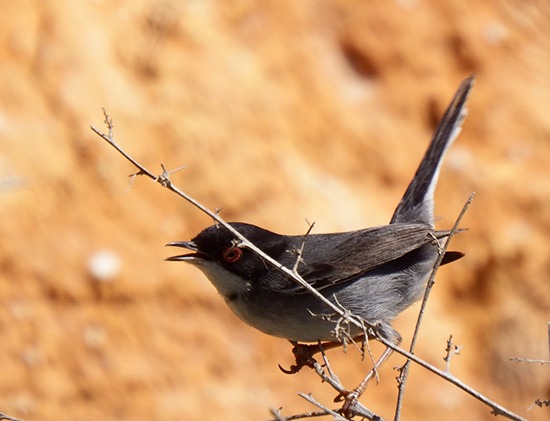
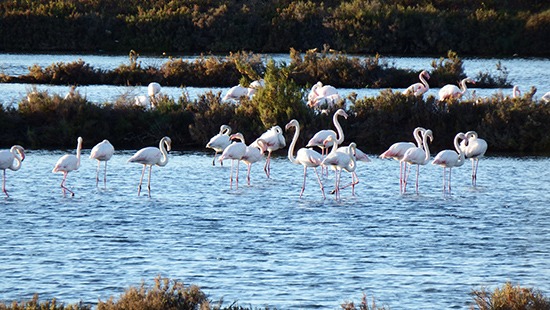
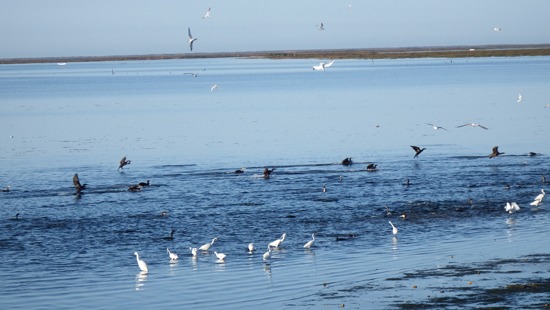
Later that day, we headed for the coast, to Sante Carles de la Rapita on the River Ebro Delta. We spent two days birding on the Punta de la Banya nature reserve and, though a little early for most summer visitors, there were several Audouin’s and Slender-billed Gulls on show, and plenty of other birds around the delta, including Little and Cattle Egret, Greater Flamingoes and Water Pipits. It was back to Barcelona on the last day, stopping off at the Montserrat Monastery: not many birds, but stunning scenery.
During our very productive and enjoyable few days, we used ‘Where to Watch Birds in Spain & Portugal’, by Laurence Rose, as our guide to the area.
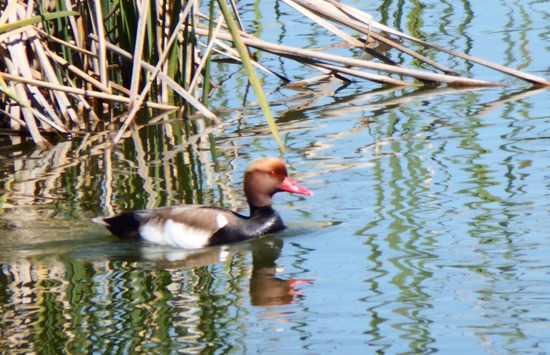
Our list of birds seen – Shelduck, Mallard, Gadwall, Shoveler, Garganey, Teal, Pochard, Tufted Duck, Red-legged Partridge, Black-necked and Gt Crested Grebes, Cormorant, Cattle, Little and Great White Egrets, Grey Heron, White Stork, Glossy Ibis, Greater Flamingo, Griffon and Egyptian Vultures, Bonelli’s Eagle, Red Kite, Marsh Harrier, Common Buzzard, Sparrowhawk, Peregrine, Merlin, Moorhen, Coot, Purple Swamphen, Common Crane, Oystercatcher, Avocet, Black-winged Stilt, Ringed, Little Ringed, Kentish and Grey Plovers, Lapwing, Sanderling, Turnstone, Little Stint, Dunlin, Wood, Green and Common Sandpipers, Redshank, Greenshank, Curlew, Black-headed, Slender-billed, Mediterranean, Yellow-legged, Lesser Black-back and Audouin’s Gulls, Sandwich Tern, Pin-tailed Sandgrouse, Rock Dove, Woodpigeon, Collared Dove, Kingfisher, Black, Greater Spotted and Green Woodpeckers, Thekla, Crested, Calandra, Dupont’s and Lesser Short-toed Larks, Woodlark, Crag Martin, Barn Swallow, Water and Meadow Pipits, White and Grey Wagtails, Dipper, Alpine Accentor, Robin, Black Redstart, Stonechat, Song and Mistle Thrushes, Blackcap, Sardinian Warbler, Zitting Cisticola, Chiffchaff, Firecrest, Goldcrest, Great, Blue, Coal, Crested and Long-tailed Tits, Nuthatch, Wallcreeper, Short-toed Treecreeper, Iberian Grey Shrike, Magpie, Jackdaw, Red-billed and Alpine Choughs, Carrion Crow, Raven, Starling, Spotless Starling, House and Rock Sparrows, Chaffinch, Bullfinch, Linnet, Goldfinch, Greenfinch, Siskin, Serin, Hawfinch, and Reed, Cirl and Corn Buntings.
To view photographs from the trip, follow these links:
Glyn Sellors –http://www.glynsellorsphotography.com/2224227-ebro-spanish-pyrenees-march-2015
Richard Pittam – https://www.flickr.com/photos/wildaperture/sets/72157649122827643/
Richard Pittam